Back to blogs
Loading article…
Blog
Longer posts — published here first, then cross-posted to Dev.to with a canonical URL back to this site.
Back to blogs
Back to blogs
Postsupabse, postgres, javascript, sql
Supabase An open source alternative to firebase...
Date published

Why You Might Still Pick Next.js Over TanStack Start From a TanStack Start...

A complete theme management system for React applications with SSR support! ✨ 🌟...
A guide to creating Android home screen widgets using Expo modules, complete with state management,...
An open source alternative to firebase offering
But wait,if they already have functions why do they need edge functions?

Supabase Functions: Your PostgreSQL Toolbox
Supabase functions, also known as database functions, are essentially PostgreSQL stored procedures. They are executable blocks of SQL code that can be called from within SQL queries.
Edge Functions: Beyond the Database
In contrast, Edge functions are server-side TypeScript functions that run on the Deno runtime. They are similar to Firebase Cloud Functions but offer a more flexible and open-source alternative.
Supabase: A PostgreSQL Platform
Beyond its role as an open-source alternative to Firebase, Supabase has evolved into a comprehensive PostgreSQL platform. It provides first-class support for PostgreSQL functions, integrating them seamlessly into its built-in utilities and allowing you to create and manage custom functions directly from the Supabase dashboard.
Structure of a basic postgres functon
1CREATE FUNCTION my_function() RETURNS int AS $$2BEGIN3 RETURN 42;4END;5$$ LANGUAGE sql;
Breakdown:
CREATE FUNCTION: This keyword indicates that we're defining a new function.my_function(): This is the name of the function. You can choose any meaningful name you prefer.RETURNS int: This specifies the return type of the function. In this case, the function will return an integer value.AS $$: This begins the function body, enclosed within double dollar signs ($$) to delimit it.BEGIN: This marks the start of the function's executable code.RETURN 42;: This statement specifies the value that the function will return. In this case, it's the integer 42.END;: This marks the end of the function's executable code.$$ LANGUAGE sql;: This specifies the language in which the function is written. In this case, it's SQL.Purpose:
This function defines a simple SQL function named my_function that returns the integer value 42. It's a basic example to demonstrate the structure and syntax of a function definition in PostgreSQL.
Key points to remember:
my_function with any desired function name.text, boolean, date, or a user-defined type.$$ delimiters are used to enclose the function body in a language-independent manner.TRIGGERS which are like functions but react to specific events like insert, update or delete on a table1SELECT my_function();
1SELECT2 proname AS function_name,3 prokind AS function_type4FROM pg_proc5WHERE proname = 'my_function';
1DROP FUNCTION my_function();
Built-in functions
Supabase makes use of postgres functions to perform certain tasks within your database.
short list of exampales includes
1-- list all the supabase functions2SELECT3 proname AS function_name,4 prokind AS function_type5FROM pg_proc;67-- filter for the session supabase functions function8SELECT9 proname AS function_name,10 prokind AS function_type11FROM pg_proc12WHERE proname ILIKE '%session%';1314-- selects the curremt jwt15select auth.jwt()1617-- select what role is callig the function (anon or authenticated)18select auth.role();1920-- select the session user21select session_use;
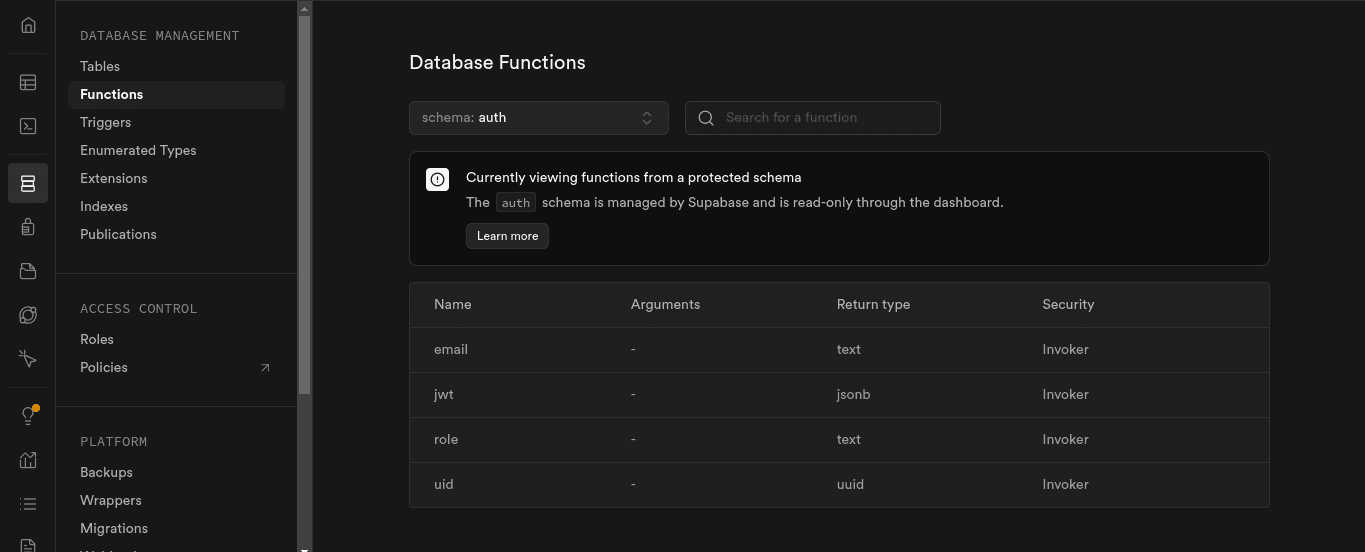
Supabase functions view on the dashboard To view some of these functions in Supabase, you can check under database > functions
Creating a user_profile Table on User Signup
Supabase stores user data in the auth.users table, which is private and should not be accessed or modified directly. A recommended approach is to create a public users or user_profiles table and link it to the auth.users table.
While this can be done using client-side SDKs by chaining a create user request with a successful signup request, it's more reliable and efficient to handle it on the Supabase side. This can be achieved using a combination of a TRIGGER and a FUNCTION.
1-- create the user_profiles table2CREATE TABLE user_profiles (3 id uuid PRIMARY KEY,4 FOREIGN KEY (id) REFERENCES auth.users(id),5 name text,6 email text7);89-- create a function that returns a trigger on auth.users10CREATE11OR REPLACE FUNCTION public.create_public_user_profile_table()12RETURNS TRIGGER AS $$13BEGIN INSERT INTO public.user_profiles (id,name,email)14VALUES15 (16 NEW.id,17 NEW.raw_user_meta_data ->> 'name',18 NEW.raw_user_meta_data ->> 'email'19 -- other fields accessible here20-- NEW.raw_user_meta_data ->> 'name',21-- NEW.raw_user_meta_data ->> 'picture',2223);24RETURN NEW;25END;26$$ LANGUAGE plpgsql SECURITY DEFINER;2728-- create the trigger that executes the function on every new user rowcteation(signup)29CREATE TRIGGER create_public_user_profiles_trigger30AFTER INSERT ON auth.users FOR EACH ROW WHEN (31 NEW.raw_user_meta_data IS NOT NULL32 )33EXECUTE FUNCTION public.create_public_user_profile_table ();34
1let { data: user_profiles, error } = await supabase2 .from('user_profiles')3 .select('*')
we need 2 tabbles
public.roles and public.role_permissions1-- Custom types2create type public.app_permission as enum ('channels.delete', 'channels.update', 'messages.update', 'messages.delete');3create type public.app_role as enum ('admin', 'moderator');45-- USER ROLES6create table public.user_roles (7 id bigint generated by default as identity primary key,8 user_id uuid references public.users on delete cascade not null,9 role app_role not null,10 unique (user_id, role)11);12comment on table public.user_roles is 'Application roles for each user.';1314-- ROLE PERMISSIONS15create table public.role_permissions (16 id bigint generated by default as identity primary key,17 role app_role not null,18 permission app_permission not null,19 unique (role, permission)20);21comment on table public.role_permissions is 'Application permissions for each role.';
example of user role
| id | user_id | role |
| --- | --- | --- |
| 1 | user-1 | admin |
| 2 | user-2 | moderator |
example of a role permission table
| id | role | permission |
| --- | --- | --- |
| 1 | admin | channels.update |
| 2 | admin | messages.update |
| 3 | admin | messages.delete |
| 4 | admin | messages.delete |
| 5 | moderator | channels.update |
| 6 | moderator | messages.update |
user with user_id = user-1 will have admin and moderator roles and can delete channels and messages
users with user_id = user-2 can only update channels and messages with the moderator role
1-- Create the auth hook function2create or replace function public.custom_access_token_hook(event jsonb)3returns jsonb4language plpgsql5stable6as $$7 declare8 claims jsonb;9 user_role public.app_role;10 begin11 -- Fetch the user role in the user_roles table12 select role into user_role from public.user_roles where user_id = (event->>'user_id')::uuid;1314 claims := event->'claims';1516 if user_role is not null then17 -- Set the claim18 claims := jsonb_set(claims, '{user_role}', to_jsonb(user_role));19 else20 claims := jsonb_set(claims, '{user_role}', 'null');21 end if;2223 -- Update the 'claims' object in the original event24 event := jsonb_set(event, '{claims}', claims);2526 -- Return the modified or original event27 return event;28 end;29$$;3031grant usage on schema public to supabase_auth_admin;3233grant execute34 on function public.custom_access_token_hook35 to supabase_auth_admin;3637revoke execute38 on function public.custom_access_token_hook39 from authenticated, anon, public;4041grant all42 on table public.user_roles43to supabase_auth_admin;4445revoke all46 on table public.user_roles47 from authenticated, anon, public;4849create policy "Allow auth admin to read user roles" ON public.user_roles50as permissive for select51to supabase_auth_admin52using (true)53
then create a function that will be called to authorize on RLS policies
1create or replace function public.authorize(2 requested_permission app_permission3)4returns boolean as $$5declare6 bind_permissions int;7 user_role public.app_role;8begin9 -- Fetch user role once and store it to reduce number of calls10 select (auth.jwt() ->> 'user_role')::public.app_role into user_role;1112 select count(*)13 into bind_permissions14 from public.role_permissions15 where role_permissions.permission = requested_permission16 and role_permissions.role = user_role;1718 return bind_permissions > 0;19end;20$$ language plpgsql stable security definer set search_path = '';2122-- example RLS policies23create policy "Allow authorized delete access" on public.channels for delete using ( (SELECT authorize('channels.delete')) );24create policy "Allow authorized delete access" on public.messages for delete using ( (SELECT authorize('messages.delete')) );2526
Improved Text:
Creating RPC Endpoints
Supabase functions can be invoked using the rpc function. This is especially useful for writing custom SQL queries when the built-in PostgreSQL APIs are insufficient, such as calculating vector cosine similarity using pg_vector.
```sql
create or replace function match_documents (
query_embedding vector(384),
match_threshold float,
match_count int
)
returns table (
id bigint,
title text,
body text,
similarity float
)
language sql stable
as $$
select
documents.id,
documents.title,
documents.body,
1 - (documents.embedding <=> query_embedding) as similarity
from documents
where 1 - (documents.embedding <=> query_embedding) > match_threshold
order by (documents.embedding <=> query_embedding) asc
limit match_count;
$$;
1and call it client side
ts const { data: documents } = await supabaseClient.rpc('match_documents', { query_embedding: embedding, // Pass the embedding you want to compare match_threshold: 0.78, // Choose an appropriate threshold for your data match_count: 10, // Choose the number of matches })
1**Improved Text:**23**Filtering Out Columns**45To prevent certain columns from being modified on the client, create a simple function that triggers on every insert. This function can omit any extra fields the user might send in the request.67
sql -- check if user with roles authenticated or anon submitted an updatedat column and replace it with the current time , if not (thta is an admin) allow it CREATE or REPLACE function public.omit_updated__at () returns trigger as $$ BEGIN IF auth.role() IS NOT NULL AND auth.role() IN ('anon', 'authenticated') THEN NEW.updated_at = now(); END IF; RETURN NEW; END; $$ language plpgsql;
```
With a little experimentation, you can unlock the power of Supabase functions and their AI-powered SQL editor. This lowers the barrier to entry for the niche knowledge required to get this working.
Why choose Supabase functions?